

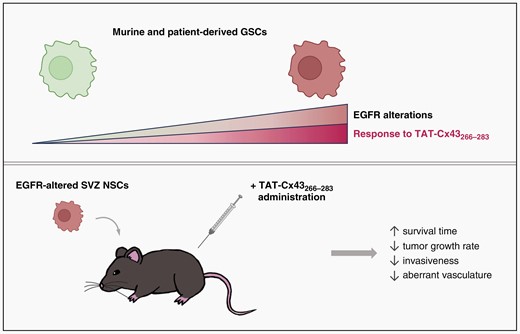
In the relentless battle against glioblastoma (GB), a recent study has shed light on a potential game-changer: TAT-Cx43. Led by Dr. Andrea Álvarez and Lab 15 at INCYL in collaboration with Pilar Sánchez Gómez´s Lab, Pollard´s Lab, and Justin Lathia´s Lab, the study’s findings, published in Neuro-Oncology, mark a significant milestone in GB research.
TAT-Cx43, a Src inhibitor, has shown promising outcomes in preclinical GB models. However, understanding its response mechanism in human GB patients has been a crucial missing piece. This study bridges that gap by revealing a key biomarker: EGFR amplification and EGFRvIII, which predict TAT-Cx43 response.
The prevalence of EGFR alterations in GB suggests a potential benefit for a substantial number of patients. Moreover, identifying biomarkers for treatment response could revolutionize patient stratification, paving the way for more personalized treatment approaches.
The study’s findings not only confirm the clinical relevance of the EGFR-Src axis but also shed light on TAT-Cx43’s mechanism of action. Particularly noteworthy is its efficacy in targeting TMZ- and erlotinib-resistant GSCs, offering hope for patients with recurrent GBM, a common challenge in GB management.
One of the study’s highlights is TAT-Cx43’s ability to target neural stem cells (NSCs) harboring GB driver mutations. By curbing tumor growth and suppressing GB hallmarks, TAT-Cx43 demonstrated remarkable potential in extending the survival of GB-bearing mice with intact immune systems.
These results underscore the promising clinical application of TAT-Cx43 in the fight against glioblastoma. As we move forward, further clinical trials are warranted to validate these findings and unlock the full therapeutic potential of TAT-Cx43 for GB patients